Rating: 4.4/5
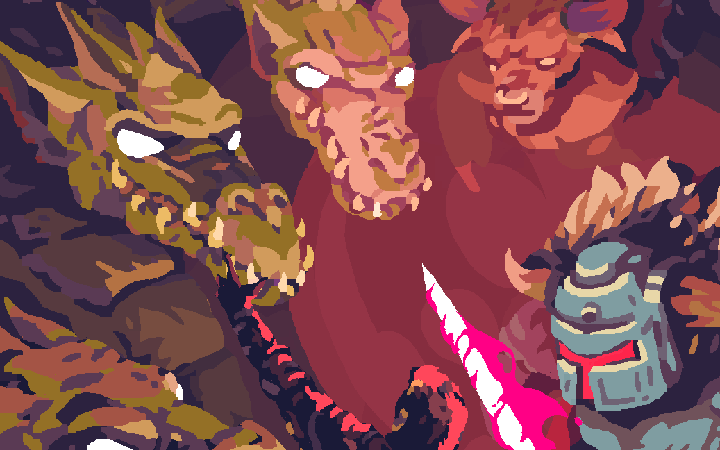
This game is pretty nostalgic for me because it was one of the first games that I played with my brother when I first got Steam. At first glance, it’s pretty hard to tell that this was a low-budget indie debut, thanks to its retro pixelated style that is fancier than it should be. However, it becomes clear as you keep playing and realize that there is a relatively small amount of content to play with. The developers are masters of replayability, though, and with their limited resources, they are somehow able to make the most out of a 2D dungeon crawler and turn it into a great party game that is surprisingly balanced.
At the start of each game, up to 4 players (you can also use bots to simulate other players if you want) each select a specific eldritch god that they want to worship. This will affect the monsters that the player can summon, and different gods have different combinations of 3 monsters out of all the monsters in the game. Then, all players are dropped into the first level of the dungeon, which will always be a dueling ground where the players have to kill each other until one remains. The last one standing will be the first one to play as the hero. Once the first hero is established, their goal is to slay monsters and level up in a procedurally generated dungeon. Once the hero reaches level 10, the portal room opens up for them to challenge the final boss. While the hero is on their journey, every slain player becomes a ghost to sabotage the hero, and whoever lands the killing blow on the hero regains their humanity and continues as the next hero seeking escape.
The ghosts can do the following:
– Haunt small objects like barrels and crates to launch them toward the hero and damage them. This will create ectoplasm for the ghosts to collect.
– With enough ectoplasm collected, the ghosts can summon slimes. These are basic enemies that mainly serve as a disruption for the hero. However, because of how monsters work, a single slime is enough to block the hero from leaving a room, buying the ghosts time to haunt traps and try to kill the hero.
– When there is a ritual circle (60% of rooms have them, usually with 2–3 per room), a ghost can haunt one to deactivate the circle and manifest as a random one of the 3 monsters associated with the god they selected at the start of the game. This is the primary way that a ghost player can try to slay the hero. As long as a monster remains in the room, the hero must defeat it to leave the room. This also allows the hero to gain XP and gold in the process.
– Ghosts can also haunt a variety of traps to control them and try to harm the hero. This is especially the case in special trap rooms, where there are crystals that the hero must destroy to leave the room, giving ghosts time to control the traps.
This might make it seem like the ghosts are pretty powerful, but in the early game, monsters without upgrades are extremely fragile and easy for the hero to kill. The hero can also use their gold to buy upgrades such as new weapons, abilities, and stat boosts to kill monsters more efficiently. As the players progress through the floors, ghost players gain wrath points to level up the monsters that they can manifest.
Overall, it is a pretty simple game, but it is how the developers perfectly balance it that makes it more impressive than other party games:
– To compensate for differences in skill, the game gives less-skilled players more wrath points to spend in proportion to their XP gain, which allows them to upgrade their monsters faster and kill the hero faster, thereby giving them a better chance of getting to level 10.
– The developers also give the ghosts a generous number of interactables so they never feel left out or uninvolved in the game.
– The ghost players all come together to control multiple segments of the final bosses, forming a final coalition to stop the hero.
These details, though small, really made me feel that the developers cared about making the most out of a pixelated dungeon crawler, and I truly believe they maximized its fun and party potential while keeping a slight sense of competitiveness alive within each round.
It’s a brilliant demonstration of the developers’ understanding of their own game and their audience.